

Welcome back to the Heart Sage Counselling sharing space.
I sometimes hear children describe other kids as having “anger issues,” and other kids say their parents have “anger problems.” Anger gets a bad name. But anger itself is not the problem. It is how we understand it, and what we do with it, that makes the difference.
Here is a gentle, whole-body roadmap to help you move from being hijacked by anger to holding it with friendliness, gentleness, and curiosity.
Step 1: Understand What Is Happening in Your Body
Before we can change how we react to anger, it helps to understand what is happening inside the body.
Deep inside your nervous system is a quiet scanning system called neuroception. Without you even realizing it, it is constantly asking: Am I safe? Am I in danger?
When your system senses a threat, like someone crossing your boundaries, ignoring your needs, or treating you unfairly, it pulls an internal alarm. Your body gets a rush of energy (including adrenaline) and prepares you to stand your ground.
- The shift: Anger is your body’s protective system in action. It is a physical wave of energy, not a moral failing.
- The practical takeaway: Because this starts in the body before it reaches your thinking brain, you can’t simply “think” yourself calm. The first step to cooling down is noticing that your body’s alarm has gone off.
Step 2: Step Back and Get Curious About the “Angry Part” of You
When anger hits, we often become the anger. It can feel like it takes over completely.
Instead of letting anger take the steering wheel, try to create a tiny bit of space, so you can look at your anger rather than from it. Think of anger like an iceberg: what you see on the surface is a fiery shield, but underneath there is often something much softer.
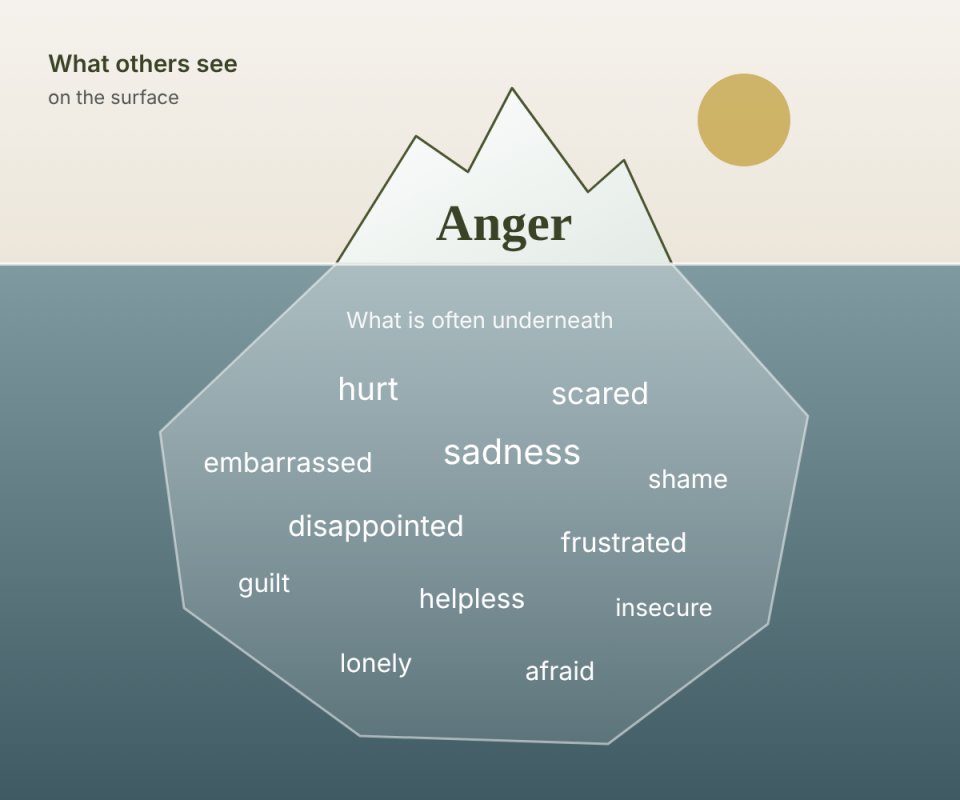
A 4-step check-in:
- Find it in your body. Where do you feel the anger right now? A tight knot in your stomach? Clenched fists? Hot shoulders?
- Step back slightly. Imagine taking half a step back from that sensation. Tell yourself: “A part of me is feeling really angry right now, and I am still here, holding space for it.”
- Check your attitude. How do you feel toward this anger? If you feel frustrated with it or scared of it, gently ask those feelings to step aside for a moment so you can bring some curiosity.
- Ask the anger some gentle questions:
- “What are you trying to protect me from right now?”
- “What are you worried would happen if you didn’t step up and get angry?”
Often, you may find that the angry part of you is guarding something tender underneath, like helplessness, sadness, hurt, or fear. Anger can be the shield that guards the wound.
Step 3: Anchor Yourself and Find the Message
Once you have stepped back from the fire, the energy of anger can help you make healthy choices. Anger is a messenger: it often tells you that something you care about is being threatened.
Drop anchor in the storm
When the heat of anger is high, you don’t have to fight it or squeeze it away.
- Acknowledge it. Say to yourself: “I feel a big wave of heat in my chest. It is really uncomfortable, but I can make room for it. It will pass.”
- Breathe out slowly. Take a few slow breaths, with longer exhales. Slow breathing can help signal to your nervous system that you are safe right now.
Ask: “What is this pointing to?”
Once your body feels a little more settled, ask yourself what value your anger might be protecting.
- If you are angry about a broken promise, your anger may care about trust and honesty.
- If you are angry about being interrupted, your anger may care about respect and being heard.
Once you know what matters to you, you can thank your anger for the alert, and make a calm, conscious choice: “Now that I know what I need, how can I set a clear, firm boundary without letting my anger drive the car?”
A Summary to Take With You: C.A.L.M.
When anger strikes, you don’t have to fight the fire. Imagine your anger as a fiercely loyal, slightly overprotective security guard who has just heard a smoke alarm go off in your body.
Instead of panicking or shouting at the guard, you can bring C.A.L.M. to the moment:
- C – Catch the alarm. Notice the moment your body’s alarm rings: the rush of heat, the racing heart, the clenched jaw. Instead of judging it, tell yourself: “Ah, the alarm is going off. My inner security guard is trying to protect me.”
- A – Allow and unblend. Instead of letting the guard take over your mind and drive the car, let them sit right next to you. Take half a step back. Imagine sitting on a bench beside your angry guard and saying: “A part of me is furious right now, and I am the calm space holding it.”
- L – Listen with curiosity. Now that you are sitting beside your guard instead of wrestling with them, listen with friendly curiosity: “I know you’re shouting for a reason. What are you guarding underneath? What do you need right now to feel safe?” You may find they are standing guard over a hurt, sad, or scared place.
- M – Move with your values. Look past the noise to what your guard is protecting. Respect? Fairness? Safety? Thank your guard for doing their job, then take a calm, firm action that honours that value, without letting the guard make a mess of the room.
By treating your anger with friendliness, gentleness, and curiosity, you stop fighting yourself. You can let the storm pass and find the steadiness underneath.
If you would like a calm, non-judgmental space to understand your anger, with someone alongside you, you are welcome to reach out.